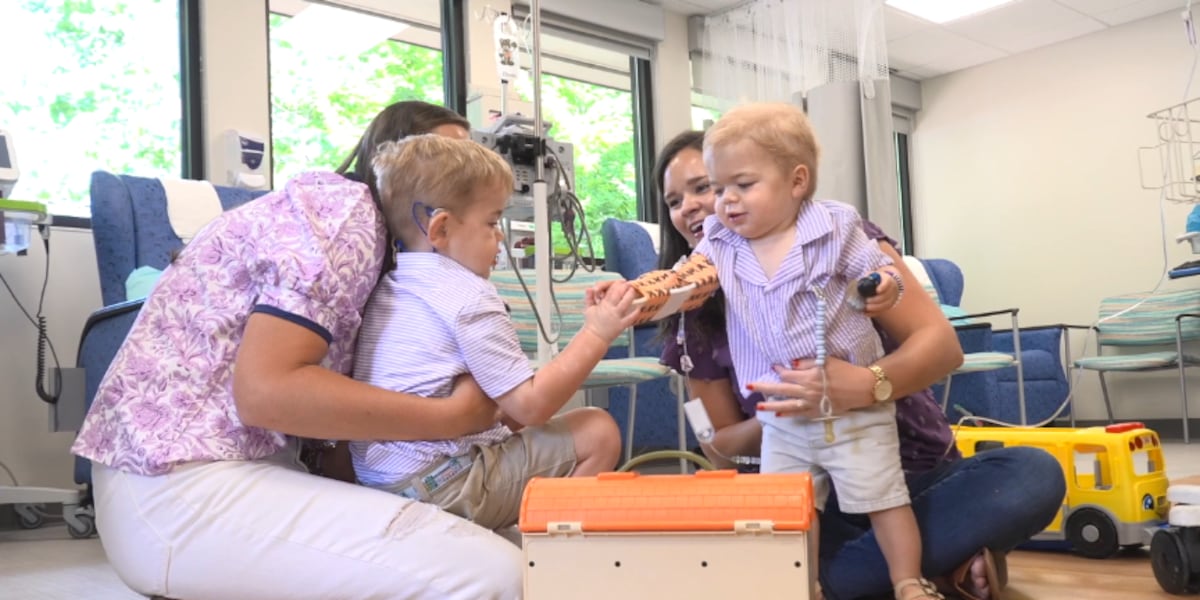
Two families in Greenville, South Carolina received the same rare diagnosis for their sons during the same week in March. Now their boys are among the first children to receive a newly approved treatment that offers a chance at slowing a devastating brain disease.
Both boys were diagnosed with Hunter syndrome, also known as MPS II, a genetic disorder that prevents the body from producing a crucial enzyme needed to break down complex sugars. Without that enzyme, sugars build up in cells and damage organs. In severe cases, the condition affects the brain and leads to developmental delays. JT, one of the boys, has neuronopathic Hunter syndrome, a more severe early onset type that affects the brain.
The same week both families learned their sons had the disorder, the U.S. Food and Drug Administration approved a new drug called Avlayah. Laura Buch, a physician assistant with the Greenwood Genetic Center, explained that previous treatments could replace the missing enzyme but could not cross the blood-brain barrier, the protective boundary that blocks many medications from reaching the brain. The new drug uses what Buch described as an enzyme transport vehicle to carry the enzyme past that barrier and into the central nervous system.
Early results have been encouraging. Buch said patients treated with Avlayah showed behavioral improvement and neuropsychological outcomes that improved over time. The two boys now receive their infusions together at the Prisma Health infusion center, where the hospital schedules both families on the same day because of the bond they have formed.
For families facing a disease this rare, finding someone who understands the experience firsthand has made a significant difference. “This specific journey is just something that’s hard to understand,” said Marie Laiewski, mother of James. “It’s very special to have another family who understands the exact struggles.”
Hannah Burgess, mother of JT, echoed the sentiment. “We know that these boys will be walking this path for life together and we truly hope that they can lean on one another, know that they are not alone,” she said.
Avlayah is not a cure for Hunter syndrome. Buch said clinical trials are currently underway exploring gene therapy as a potential path toward a cure. For now, the families hold onto the progress already made. “This treatment is important to us,” Laiewski said. “Now there is hope.”