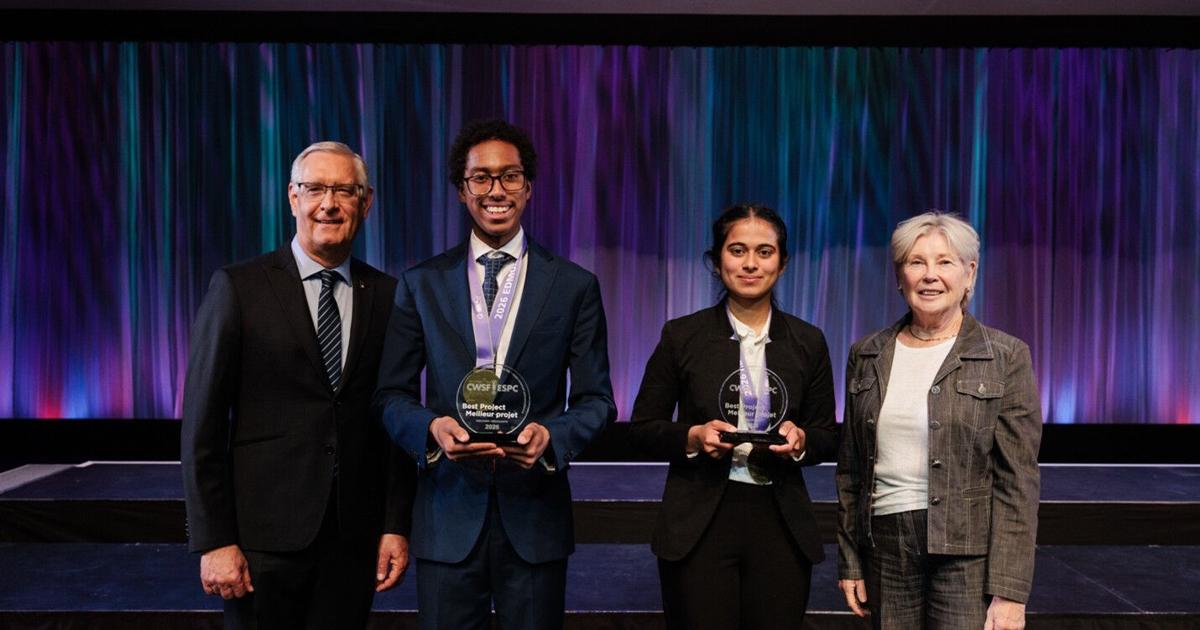
Two Canadian teenagers have claimed top honours at the 2026 Canada-Wide Science Fair for projects that tackle fundamental questions in cosmology and correct a long standing flaw in medical devices. The awards, presented Thursday evening in Edmonton, recognized a Grade 9 student who proposed a new explanation for the expansion of the universe and a Grade 11 student who identified a 35 year old error in blood oxygen sensors that has disproportionately harmed Black patients.
The fair brought together 390 finalists from across Canada, who competed for nearly $2 million in prizes. Gurnoor Kaur, a Grade 11 student from Waterloo, Ontario, received a Best Project Award for Eigenpulse: Eliminating Demographic Bias in Pulse Oximetry and Remote PPG from First Principles. Her project corrected a flaw in pulse oximeters, devices that measure blood oxygen levels, that has contributed to higher mortality among Black patients for more than three decades. The sensors work by shining light through the skin, but darker skin absorbs more light, leading to inaccurate readings. Kaur’s approach reengineers the underlying physics of the measurement to remove this bias, potentially making the devices safer for all patients.
Liam Desre, a Grade 9 student from Kingston, Ontario, won the other Best Project Award for ΛCDM+S - Thermodynamic Cosmology: Simulating The Universe's Expansion Without Dark Energy. His project proposes a credible alternative to the standard model of cosmology, suggesting that the universe’s expansion can be explained through thermodynamics rather than requiring the mysterious force known as dark energy. Reni Barlow, executive director of Youth Science Canada, said the achievements demonstrate what young people can accomplish when their curiosity is supported.
Other notable projects included Siddharth Patel, a Grade 7 student from London, Ontario, who developed an automated system to help citizen astronomers identify genuine asteroids. Audrey Cowen, a Grade 11 student from Toronto, found compounds that reverse drug resistance in a common fungus by blocking its molecular pumps. Willem Vuurmans, a Grade 8 student from Vancouver, built a computational tool to evaluate potential treatments for brain diseases by modeling how drugs cross the blood brain barrier. Siddharth Rajesh, a Grade 9 student from Toronto, created an AI platform to rapidly design DNA sequences for detecting disease related proteins, offering a faster path to diagnostics for conditions like sepsis.
What Happens Next
The public can view the winning projects online and attend a panel with the top winners on Friday morning in Edmonton. The 2027 Canada-Wide Science Fair will be held in Hamilton, Ontario. Organizers say the innovations from this year’s fair, especially the correction of a decades old medical device flaw, point to a future where young scientists are driving meaningful improvements in health equity and patient safety.