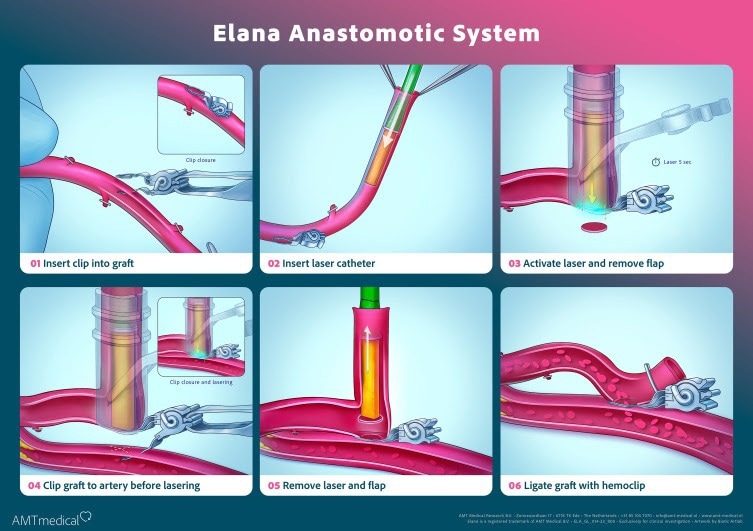
A new technology that replaces the surgeon’s needle and thread with a titanium clip and a controlled laser pulse has passed its first major clinical test, offering a potential path to faster recovery and less invasive heart surgery for millions of patients worldwide. One year results from the SAFE-CAB II trial, published in a peer reviewed journal, show that the ELANA Anastomotic System can safely perform the most delicate step of coronary artery bypass grafting without stopping the heart or clamping the artery.
Coronary artery bypass grafting remains the most durable treatment for advanced heart disease, with about one million procedures performed each year. Yet the core technique for connecting a bypass graft to the diseased artery has relied on hand sewn stitches since the 1960s. The new system replaces those eight to twelve stitches with a defined six step mechanical process. The surgeon attaches a small titanium clip to the coronary artery and then fires a precise laser pulse to create a clean opening inside the clip. Because the connection is made before the artery is opened, blood continues to flow to the heart muscle throughout the entire procedure.
The trial enrolled 71 patients with an average age of 71 who underwent elective bypass surgery at centers in the Netherlands and Germany. All angiographic data were independently reviewed by a leading academic core laboratory. The results provide the first prospective clinical evidence that a sutureless, flow preserving connection is safe and effective in humans. For patients, this technology is designed to enable minimally invasive and robotic bypass approaches, which published studies have linked to smaller incisions, less surgical trauma, shorter hospital stays, and faster return to daily life. For hospitals, an internal health economic assessment based on benchmark data estimates that direct bypass related hospital costs could be reduced by 35 to 50 percent at scale, driven by fewer complications and shorter intensive care stays.
What Happens Next
The ELANA technology was originally developed for brain bypass surgery and has been used in more than 1,000 patients worldwide since receiving CE marking in 2008 and FDA clearance in 2012 for that indication. Over the past decade, the company re engineered the platform specifically for coronary anatomy. With the SAFE-CAB II results now peer reviewed and published, the company is moving toward the next regulatory and commercial steps. These include seeking CE marking for open and minimally invasive indications, submitting an Investigational Device Exemption to the FDA in collaboration with leading U.S. centers, and launching next generation trials in minimally invasive and robotic surgery. The company has raised over EUR 40 million to date, including a USD 25 million Series B in 2025. The goal is to make high quality bypass surgery with faster recovery and fewer complications available to many more patients than today.