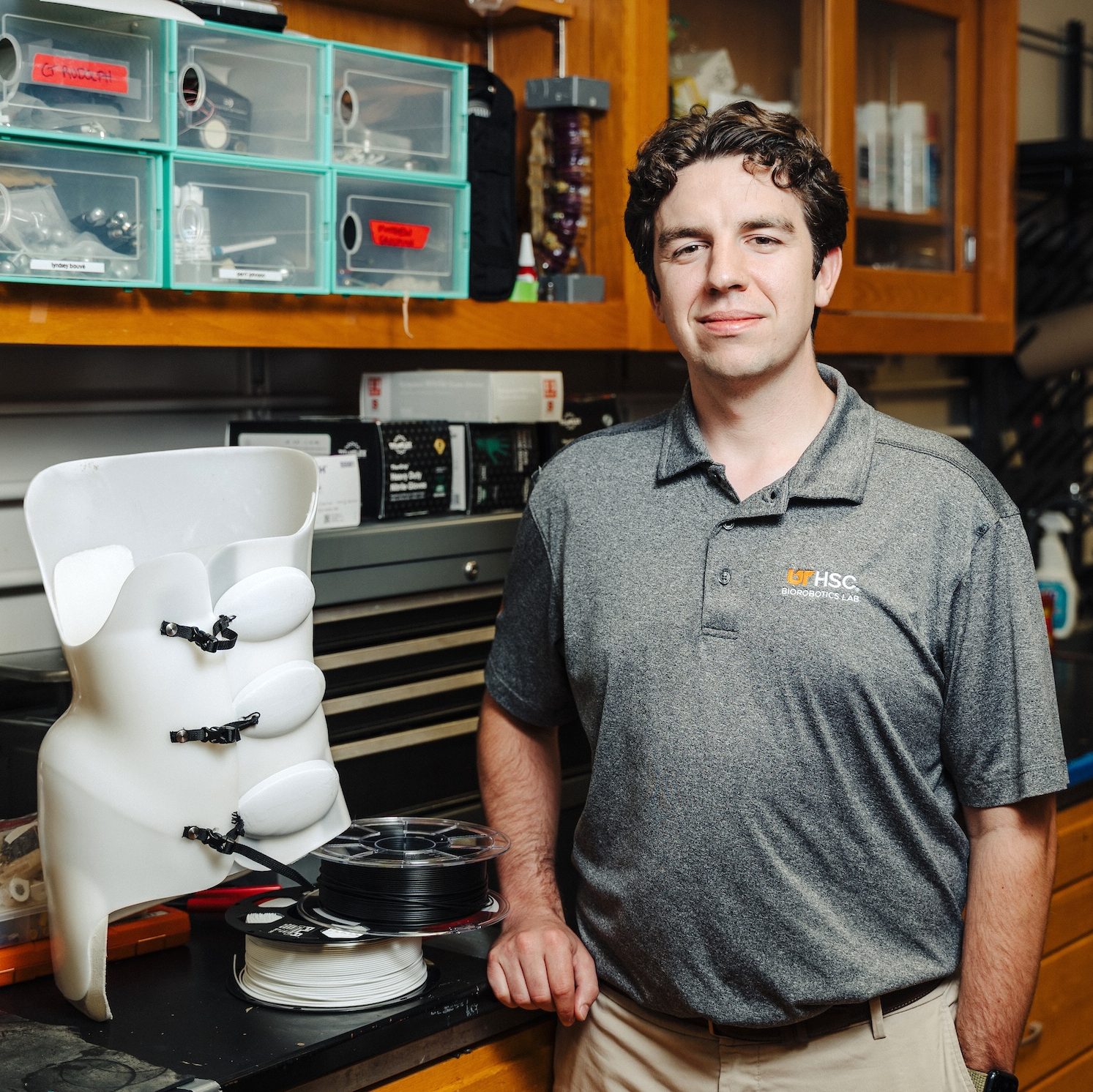
A biomedical engineering student who landed from his honeymoon at 1 a.m. pitched a new scoliosis brace accessory to investors hours later and walked away with $5,000 in seed funding. CJ Rudolph, a third-year PhD candidate at the University of Tennessee Health Sciences, developed the Constant Tension Unit, a device designed to replace the Velcro-style straps on traditional pediatric back braces.
Children with scoliosis typically wear rigid plastic braces for 18 to 23 hours a day. The hook-and-loop fasteners on conventional braces loosen over time, reducing corrective pressure and making the braces uncomfortable and restrictive. Rudolph and his labmates created a spring-loaded accessory housed in a custom 3D-printed enclosure that maintains steady corrective tension while allowing children to move and breathe more freely. Early testing shows the device holds tension more consistently than standard straps. Because it attaches to an existing FDA-approved brace rather than replacing it, the technology may follow a streamlined regulatory path.
Rudolph’s pitch came at the end of a two-day workshop called “From Discovery to Impact,” which introduced faculty, graduate students and postdoctoral fellows to the commercialization process. The event featured talks from technology transfer experts, investors and entrepreneurs. It concluded with a pitch competition where three participants each received $5,000 in seed funding. Rudolph had prepared slides a year earlier but learned the competition would be entirely verbal. Running on about six hours of sleep and two cups of coffee, he memorized his bullet points and presented without visual aids. “I felt like I was fumbling,” he said. When the winners were announced, he was stunned.
Building an Entrepreneurial Culture in Health Sciences
The workshop was organized by the university’s research office in partnership with the UT Research Foundation, Life Science Tennessee and Launch Tennessee. Organizers say the goal was to give researchers a low-pressure environment to take the first step toward turning their science into real-world treatments. “It’s absolutely essential to get the research we’re doing in our labs out into the real world,” said Dr. Jessica Snowden, vice chancellor for Research. She noted that entrepreneurship is especially appealing to younger scientists and can help attract the next generation of researchers.
Rudolph credits his advisor and a guest lecture from a technology transfer official with shifting his mindset. “Professors and students will work on things for their whole career and never take it out of the lab,” he said. “That’s what the whole goal should be, to take this to people that are actually going to use it.” His team has already begun working with pediatric orthopedic surgeons at Campbell Clinic and Le Bonheur Children’s Hospital to evaluate the device.
The university plans to make this kind of support a regular part of campus life rather than a once-a-year event. For Rudolph, the whirlwind day from honeymoon to pitch table may end up being remembered not as an outlier but as a preview of what is coming next.