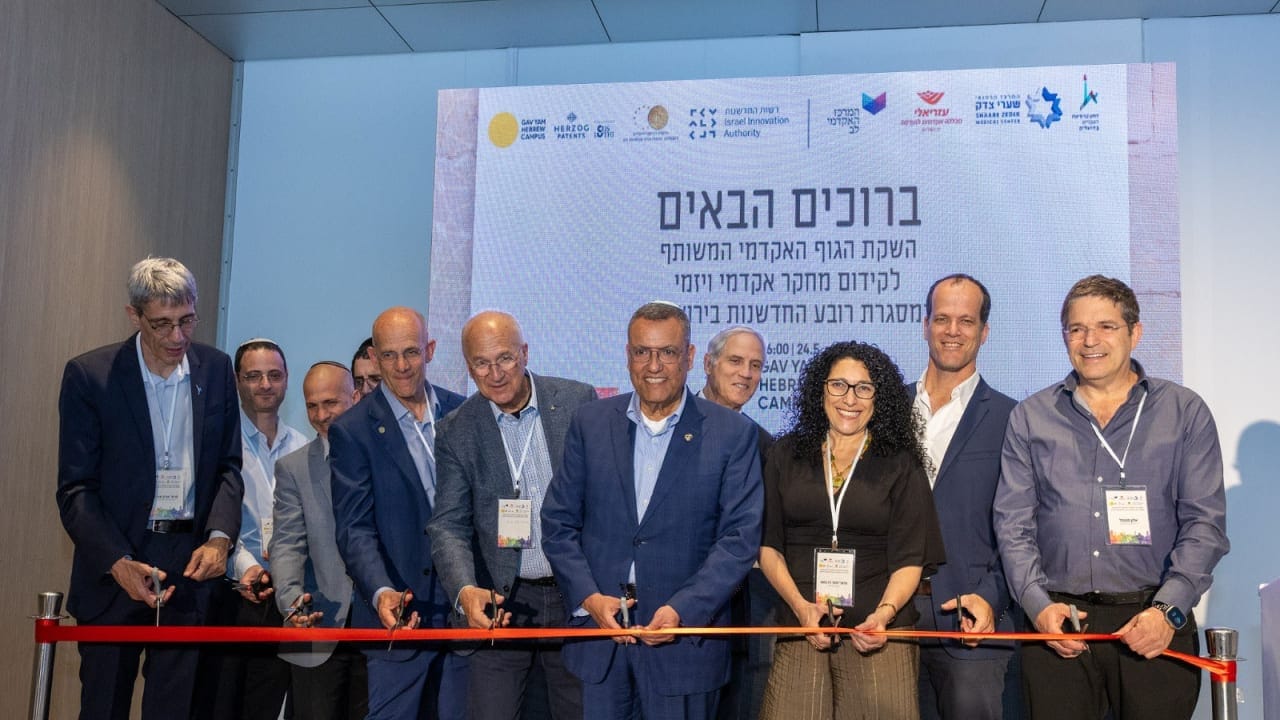
A groundbreaking collaboration in Jerusalem is bringing together academia, hospitals, and engineers under one roof to accelerate medical breakthroughs, with the launch of FourWard, Israel’s first joint academic body dedicated to research, innovation, and entrepreneurship. The initiative, announced last week at Hebrew University’s Givat Ram campus, aims to create a physical hub where researchers from four institutions can share ideas over coffee and in meeting rooms, rather than relying on Zoom or email.
The partnership unites the Hebrew University of Jerusalem, Shaare Zedek Medical Center (SZMC), Azrieli Jerusalem Academic College of Engineering, and Lev Academic Center, along with the Jerusalem Municipality and Jerusalem Development Authority. The goal is to foster multidisciplinary collaboration that leads to applied research, technology commercialization, and new startups. A public company owned by the partners will manage the platform, with Azrieli and Lev each covering a sixth of initial expenses, while the other two partners allocate a third each. Organizers expect the effort to open high-level jobs and attract qualified personnel to live in Jerusalem.
Early examples of potential projects include using joint patient databases to analyze thousands of drugs for protective or harmful effects, with all data kept private and anonymous. SZMC’s Prof. Dan Turner described a vision of tiny robots that could be introduced into the body to fix blocked coronary arteries without catheters, recalling the 1966 film “The Fantastic Voyage.” Other collaborations include improving hip replacements, treating bone infections, and developing a chip left in the body to identify early infections so antibiotics can be given faster. SZMC is also the first in the world to use an AI system that predicts blood test results with 99.5% accuracy, helping doctors decide which tests to add or remove.
“We aim not to write journal papers but to create new technologies,” said Lev Academic Center president Prof. Avi Domb, acknowledging the challenging global funding environment. He noted that FourWard will be a place to meet, discuss in shared spaces, hold seminars, and coordinate, rather than replacing each partner’s research facilities. Dr. Renana Ofan, director of SZMC’s Research and Development Authority, added that doctors will initiate projects because they see patients’ distress daily and know what is needed.
President Isaac Herzog sent congratulations at the opening ceremony, affirming that the Jerusalem Innovation District will “catapult the capital a big step forward.” With a focus on bioconvergence, a field merging biology, engineering, and computation, the partnership aims to produce breakthroughs in personalized medicine, regenerative therapies, and bio-inspired materials. Organizers are optimistic that despite global competition for grants, FourWard will create an innovation ecosystem compelling enough to attract partners and investors, proving that collaboration across disciplines can yield results greater than the sum of its parts.