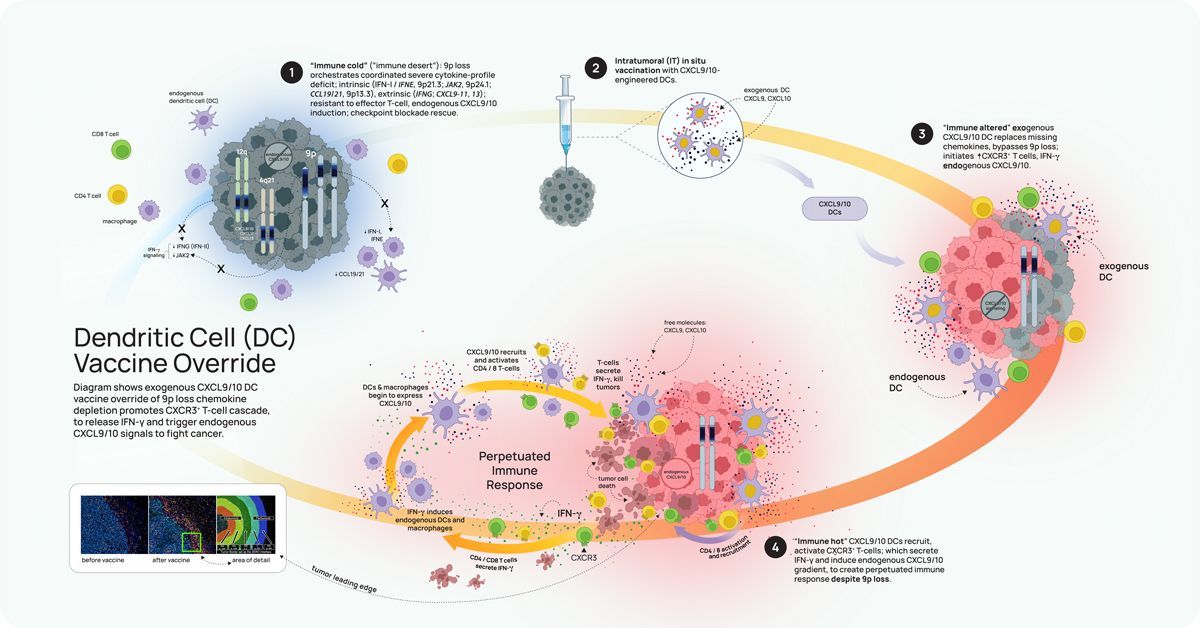
In a significant stride forward for cancer immunotherapy, researchers have pinpointed a key genetic mechanism that allows tumors to hide from the body's defenses, and this discovery is already paving the way for a promising new vaccine. The work centers on a common challenge with immune-checkpoint therapy, a revolutionary treatment that has reshaped cancer care by empowering a patient's own immune system to attack tumors. Despite its success, many patients see little benefit because their cancers become "cold," or immunologically evasive. A new, collaborative study now offers a clear explanation for this resistance, tracing it to the loss of specific genes on a region of chromosome 9, and providing a tangible new strategy to heat these tumors back up.
The investigation builds on a pivotal 2021 finding that identified the loss of genetic material on the short arm of chromosome 9, known as 9p, as a major driver of resistance to immunotherapy in certain head and neck cancers. That initial research revealed that this chromosomal loss led to a dramatic drop in crucial signaling proteins called CXCL9 and CXCL10, which are essential for recruiting cancer-fighting T-cells into the tumor. This discovery was rapidly validated and extended to other cancers, including lung and bladder cancers, and even led to the development of clinical tests to identify patients who may not respond to certain immunotherapies. Yet a fundamental mystery remained: which specific genes on 9p were responsible for this silencing of the immune response?
The latest research, uniting teams from across the country, has solved that puzzle. The scientists discovered that all human type-I interferon genes, a family of powerful immune signaling molecules, are located precisely on the 9p chromosome. They found that when tumors lose these interferon genes, they create an "immune-deserted" state. This deficiency makes it extraordinarily difficult for the body to produce the necessary CXCL9 and CXCL10 signals, effectively shutting down the highway that guides T-cells to the cancer. Remarkably, the study singled out one particular understudied interferon, IFNε, as a primary cellular link between the genetic loss and the suppression of the entire immune recruitment pathway. This identifies a clear target for intervention.
Intriguingly, the research also sheds light on why this form of resistance is so common. Analysis of thousands of tumors revealed that chromosome arm 9p is one of the most frequently completely deleted regions in the entire cancer genome. This is not a random accident but appears to be a calculated evolutionary move by tumors. There is strong selective pressure for cancer cells to deeply delete these interferon genes, as doing so provides a powerful survival advantage by cloaking the tumor from immune detection. This understanding transforms the 9p loss from a mere biomarker into a central mechanism of immune evasion that researchers can now actively combat.
The most immediate and hopeful outcome of this work is the spark it has provided for a new therapeutic approach. By understanding that the loss of type-I interferons cripples the tumor microenvironment, the research teams have leveraged these insights to develop a novel immune-cell vaccine. This vaccine is designed to reprogram the internal landscape of tumors with 9p loss, effectively reversing the cold state and making them vulnerable again to immunotherapy. While further research and clinical trials are needed, this work represents a crucial shift from simply predicting treatment failure to actively engineering a solution, offering renewed hope for personalizing and enhancing care for many patients who currently have few options.