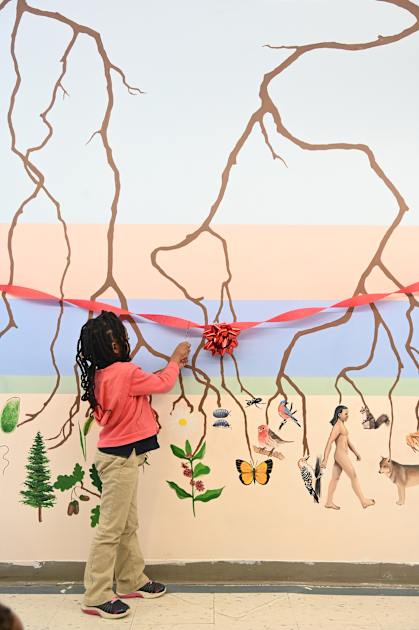
In a vibrant fusion of science, art, and community, a groundbreaking project in New Haven is redefining how students connect with the living world. The initiative, known as The Tree of Celentano Life, began not in a distant laboratory but on the school grounds themselves, where students embarked on a hands-on biodiversity survey. Armed with curiosity, they documented the plants, fungi, birds, and insects thriving in their own neighborhood, learning the fundamental practices of observation and classification. This initial "bioblitz" transformed the local environment into a living classroom, fostering both environmental awareness and a tangible sense of discovery among the young participants.
The journey of their collected data was just beginning. The species identifications were then passed to researchers at the Yale School of Public Health, where scientists in the Townsend Lab used them to construct a detailed evolutionary map. This scientifically rigorous phylogeny, or "time tree," illustrated a profound narrative, showing how the familiar species from the schoolyard are interconnected through hundreds of millions of years of shared history. This step bridged the gap between a simple list of local wildlife and the grand, sweeping story of evolution, providing the students with a direct link from their fieldwork to advanced university research.
The project’s final, breathtaking phase made this complex science visible for everyone. Connecticut artist Oksana Tanasiv translated the evolutionary framework into a magnificent mural inside the Celentano Biotech, Health and Medical Magnet School. Her artwork wove the students' specific discoveries into a beautiful, branching tree of life, rendering abstract biological concepts concrete and personal. The mural’s unveiling was a community celebration, attended by students, faculty, families, and local residents, all sharing pride in a collective achievement that literally painted a new picture of scientific learning on the school walls.
At its heart, The Tree of Celentano Life embodies a powerful educational philosophy. It proves that science education resonates most deeply when it is participatory, rooted in place, and woven into students' lived experiences. By collaborating directly with educators, young learners, and a professional artist, the project presented evolutionary biology not as a remote theory about exotic creatures, but as a visible and engaging story unfolding in their own backyard. This approach makes the science feel immediate, accessible, and profoundly relevant.
Supported in part by the National Science Foundation, this partnership between an academic institution and a public school district stands as a hopeful model for the future. It demonstrates how blending rigorous research with hands-on education and creative expression can foster scientific literacy, environmental stewardship, and a strong sense of community. The lasting mural serves as a daily reminder that when science is a shared endeavor, it has the unique power to inspire lasting curiosity, inclusive participation, and a joyful sense of shared discovery for all involved.